Where I live part 1

This is way up hereThis might be a boring post to some but there are few of you that I know will enjoy the simplicity of it (I hope). I thought I would post photo’s of our apartment and where we live. I know that Mark has done a video of our place but I thought I’d do some random views of our apartment  and views and happenings around us. You can take a stroll with me through Park Avenue (where we live) and also see scene’s from our daily life. Pretend like you are walking around with me and I’m talking your ear off because I miss all of you.

The park at nightThis is Chaoyang park at night. We can see this view from about 6 windows in our apartment. There are always people there flying kites,roller skating and skateboarding,doing Tai Chi in the morning and exercising. It’s a great park.


Typical site Next we have a typical view of what you see on the roads. Big bus with a bike carrying tons of stuff on the back going down a major road. These are most likely recyclable items and it’s a small load compared to most. One day I will post the bikes carrying a mound of garbage to be taken somewhere to be recycled.


Room with a view
This is the view from my bedroom window. The traffic is going non-stop and only dies down in the middle of the night. I’m for sure not in Kansas (aka Seattle) anymore.


A new mom,baby,grandma and me I’ve started working with my Chinese tutor. Her name is Seven and she comes three days a week for two hours each time. I feel like a lot of the time she says a word or couple of words, I repeat what she says (at least I think I do) and then she says “no” and then repeats it again. This goes on for a while and then I finally get it but then an hour later I try to say it again and of course I trash it. This is going to take some time. Oh this is a photo of Seven (on the right), her two month old cutie baby and then Seven’s mom. She comes with and takes care of the baby. Seven is so good to me that she travels and hour each way to come tutor me. I’m very grateful to her and her mom.

Bing is good!This is our favorite dessert right now and I’m sure the hotter it gets we will love it even more. This place we go to serves it with Strawberries but there will be places in the summer that use all kinds of fruits,red beans and chocolate. It’s called Bing and it’s so refreshing. Sofi says it’s healthy because it has milk and fruit.


Miles with Mrs. Kader his teacher This is Miles with his wonderful 1st grade teacher, Mrs. Kader. Miles loves school and loves his teacher. He use to get upset on Sunday night when he asked if he had school the next day and we’d say “yes”. Now he asks “do I have school tomorrow” and when we tell him yes, he just says “oh good”. No whining, there are no “ughs” or complaints. He’s adjusted very well and really enjoys his school.

This is the end of “where I live part 1”. There is much more to follow. There will be more photo’s but of our apartment and the area around us.

Categories: By Stacey, friends, living in beijing | 3 Comments

Guilin and Yangshuo

City by the Li River

When you visualize the iconic images of China what do you think of? In the top 4 have to be Mao Zedong, The Forbidden City, The Great Wall and finally Guilin with its fantastic karst mountain topography. There is a common saying in Chinese : 桂林山水甲天下 : Gulin’s scenery is the most beautiful under heaven. We set out for ourselves to find out.
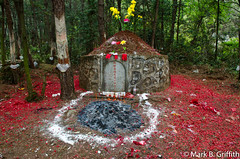
QingmingjieApril brings Qing Ming Jie or Tomb Cleaning Festival when Chinese clean their ancestors graves and preform traditional gestures of veneration like burning money to ensure and firecrackers. The kids had a week off of school and so we headed out for our first local vacation in China. Originally I had debated over Yunan or Gulin, in the end we decided to head for Gulin for warmer temperatures and lower elevation.
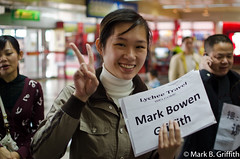
Welcome to GuilinOur departure was not without its own difficulties but we finally managed to arrive in Guilin after our three hour flight from Beijing. The warmer temperatures and the humidity immediately reminded us of our time when we lived in Taiwan, almost 15 years ago. The Guilin airport is west of town and the travel agency arranged for a van to transport the four of us and our backpacks into town to our hotel. The ride in takes around an hour and winds its way through the karst scenery that the area is known for. Limestone has eroded leaving small “mountains” that dot the landscape and are heavily covered in vegetation. The geography is surreal and stunning and is emblazoned on every 20 rmb note.
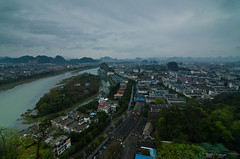
Gray Guilin DawnOur plan was Guilin for 3 nights, Yangshuo for 3 nights and one night at LongShen, the terraced rice fields. I was so busy with work I didn’t have a lot of time to research the “perfect place” and so I opted for an online travel agent to do the booking and the 5-star hotel option. One thing though I had spent a bit of time researching was trying to find someone local to the Guilin area to help orient us and point us in the right direction. Through ctrip I came across a blog written by a Bradford Fried who waxed poetic about the natural beauty of the area. I googled him, found an email address and dropped him a note. He emailed me back a week later and he said he knew a local, whose English name was Kolok, who would be perfect to show us the local sights. I was mostly interested in finding places for dawn patrol and sunrise photos early early in the morning while the kids and Stac woke up.
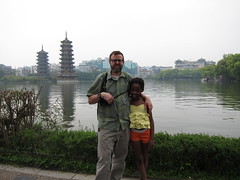
Guilin pagoda's.On our way to the hotel we passed by two pagoda’s that were built beside a lake. We asked the travel agent how old they were, she said 5. We of course assumed there was a miscommunication and that she had meant 500 years. We checked into our hotel and wandered across the street that was framed in a green canopy of osmanthus trees. The Chinese name for osmanthus is Gui and Lin means forest. We walked beside the river in the warm afternoon air. We were approached several times for boat tours on the Li River, but we held off. We purchased some sugar cane, which Sofi loves to chaw on, some fresh corn on the cob and some lychees. We immediately noticed that despite this being a tourist destination, we were stared at much more than we ever were in Beijing. We get more than our fair shares of stares anyway because our family is mixed. Sofi and Miles draw a lot of attention. People love to come up and touch their hair, or snap a photo slyly with their camera phone or sometimes they’ll even ask to have their photo taken with them. Miles and Sofi thankfully are good sports about it and don’t seem to mind at all.
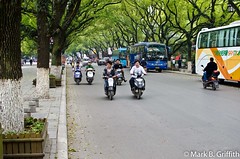
Guilin LaneAt 5pm we met Bradford and Kolok in the lobby. Kolok arrived first and he had long hair down past his shoulder and a braided band on his forehead. Not your typical Chinese look. While traveling with him I noticed he got almost as many stares from local folks as did Sofi and Miles and myself. Bradford was there to introduce us to Kolok and tell us a bit about Guilin. We accompanied them down the street to a rooftop tea shop where we overlooked the Li River and Elephant Hill. Bradford has lived in Guilin for the past 8 years and told us how much Guilin has transformed itself over the past several years. The pagoda’s we saw were in fact 5 years old not five hundred. The lake beside them : man-made around the same time. Later as we walked to dinner we passed by copies of the Golden Gate Bridge across one river, the Arc de Triumph in a park and the Louvre Pyramid in a plaza. Why try something new when you can re-use time-tested icons that are loved the world over. That evening as we went home it was dark and Guilin had neon lighting up the streets, the trees and bridges along the river. Despite all the nature given how popular Guilin is there is a lot of odd tourist aspects to the town.

However no matter how gaudy or “built up” Guilin is, its much smaller than other Chinese “big cities”, like Shanghai or Beijing. Things move slower, they seem a bit more languid, and the tourism isn’t in your face. There are of course the list of things you have to do while in Guilin, the tourism websites will spell those out. This is the same of most places you visit. If you go to Seattle you have to visit the Space Needle and Pikes Market. If you go to Paris you have to see the Louvre and the Eiffel Tower. The reasons are multi-faceted : many of these things are really amazing, but their promotion and attraction often create crowds and commercialize them. I try to dabble in these “must do’s” sparingly and attempt to find ways to see or experience them without the crowds; sometimes the people are unavoidable but often you can find a quieter way to visit the must sees. For example I’ve visited the Great Wall five times, but never the section where most tour companies go and I rarely see many people. It’s one reason for Dawn Patrol, people typically aren’t up early. It’s also very important to me sample the amazing that aren’t on the must see list; these might be called the local places. The secret favorites of the natives that have less visitors but are just as amazing.
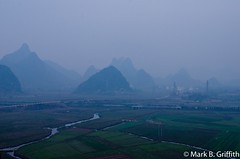
Guilin Dawn PatrolKolok, our local guide was my answer for this in Guilin and Yangshuo. When finding a guide I think its important to find someone with similar tastes. If you are a 65 year old retired German couple (not that there is anything wrong with that) Kolok is probably not your guy. He’s easy going; he loves the outdoors; he loves to hike and camp and bike around the countryside. Things I also enjoy. My first morning on Saturday we rented bikes (15 rmb a day) and left the hotel at 5am. In 10 minutes we were outside the city limits and biking in the country side. We were headed for Chao Yang Dong : The Cave that faces the Rising Sun. This is small karst mountain in the countryside. Midway up the mountain side there is a cave that pierces the mountain from east to west; a small trail leads to the caves entrance. The story goes that originally this was a Daoist temple, you can see some evidence of a gate on either end of the cave and cooking area inside the cave. We climbed up the trail in the dark and sat on the east side waiting for the sun to rise. Pitch black we could see the scooters and farm trucks coming down the road every so often. Gradually the sky began to lighten and dawn came. No sunrise to speak of but the misty views slowly revealed layers of karts in the landscape beyond as we watched people wander out into fields among the irrigation rivers to weed and plant.
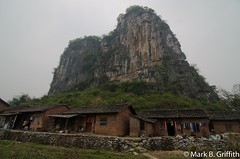
Chao Yang DongAs we descended I thought perhaps we could walk out into the field to the small river for some photos. What was a beautiful scene from above, below became a dull field with power lines across the horizon on the ground. We walked back to our bikes passing a small row of homes that migrant workers rented from the landlord. They tended to the fields as a way to augment their meager incomes with fresh vegetables for food. Kolok said they probably were farmers from a countryside far away that performed menial jobs in Guilin like cleaning bus terminals, or sweeping the streets of the evergreen osmanthus leaves that fell every day along the avenues.
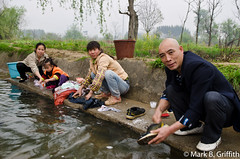
Country Washing StationWe pedaled through the countryside among the small village settlements. We passed several locations where people were washing their clothes by hand in the streams. Chatting happily as they scrubbed their clothes. They would later hand them outside their homes to dry. Our modern conveniences that we “must have” are not even a consideration; their income is insufficient for such luxuries where time and labor will suffice. This also applies to the method of farming. Fields are cleared by hand with scythes and shovels. Ground is broken with a plow and water buffalo as power. There are no large tractors with plows, human capital powers most everything in China. We passed one group of farmers working in the field, I thought they were farming but found them instead building a ditch and flattening out ground for a access road to the fields. The government had supplied money for the project. Gravel was supplied by the two stroke carts that farmers do use to haul everything around.
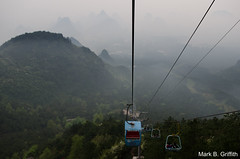
Riding up Yao MountainThat afternoon the kids and myself took bus #24 east out of Guilin to Yao Shan (Yao Mountain). A taxi would have only cost around 25-30 rmb (4-5 dollars US) but a bus ride would cost us 6 rmb, around $.90. I’ve become much more sensitive to price over here, its easy to think only in US dollar but I’ve tried to switch gears mostly in an effort to not be so callous to local sense of cost. I feel its rude to at times be so cavalier about spending what are large sums in local currency around the local people I interact with. Yao Shan is a large mountain that has commanding views over the city, the Li River and unending ridges of karats that surround. There is a tram we rode to the top, as we did we saw college kids who didn’t want to pay the fee and were hiking up. Halfway up there is an alpine slide that we planned to ride back down. The higher we got the more the mist blew in and at the top a slight rain began to blow. We wandered among the clouds, the rain and the spring blossoms. As we rode down the tram we were informed that the alpine slide was closed due to rain. Horrific crying and whining ensued from the kids who were sorely disappointed and blamed me for going all the way to the top and taking too many photos. It wasn’t raining when we passed the slide half way up, but it was my fault for the rain by the time we got down. We’d walked up the road from the bus stop and they were non too interested in walking back. We caught a motor-cycle taxi (a motor cycle front, with a large flat covered platform with bench seats in the back) back down to where we were able to catch a taxi back into Guilin city.
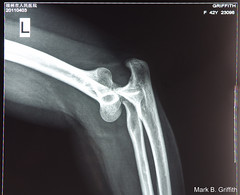
BeforeThe next day the kids and myself went with Kolok to the most famous park in Guilin : Seven Star Park . This park is “huge” and has a fee to enter. Inside there are many many acres of park with activities. You could spend an entire day just exploring this park. We headed up one of the peaks searching for the groups of wild monkeys that had escaped from a local zoo years ago and now prospered on their own. After an hour of exploration we never found them; I got a call from Stac who was sobbing in pain. She’d fallen in the hotel and was sure she’d broken in her arm. We hurried home and Kolok accompanied us to the Gulin People’s Hospital. We went to the emergency room where we admitted her and we started the X-ray process.
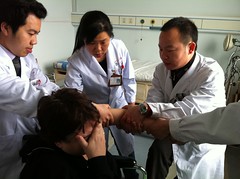
Dislocated ElbowThe ER doctor was for sure that she’d broken it. Up the hallway in an wheel chair to the elevator, down a floor to the X-ray room. Excruciating pain as they moved her arm into position and took 4 x-rays. Back up the elevator and down the hallway to the ER doc : dislocated. Then back down to see the arm doctor who confirmed the dislocation. He and a group of 3 other students grabbed her arm and “yanked” it back into place. Stac had tears of pain streaming down her face. Typically in the US they give you anesthesia before resetting a dislocation, but not in China. Then back up two floors to the the x-ray room for more x-rays to ensure that things looked ok. Then back down to wait with the ER doc and then more waiting while they consulted the arm doctor. Throughout this Stac was in great pain. We had asked the ER doc, with Kolok translating, several times for pain medication and he just brushed us off. He said they had a topical spray that they would give us, which was so good it had been exported to America. We pushed him again for pain meds and in the end he prescribed 5 pills of a very weak pain killer. We went down to pay our bill and that’s an involved process of a clerk taking all of the hand written notes for each procedure and prescription and entering into the computer. Finally we paid, the entire cost was 863 rmb ($132 US), and this was before insurance (who knows how long it will take to figure out how to bill Aetna Global); if your lucky this is what your deductible would be in the US after the 1000 dollars the ER charged you. Kolok noted that this was very expensive to him and if he’d had such a condition he’d have just had two friends pull his arm back into place.
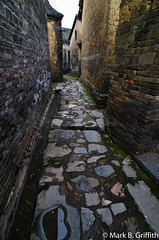
JiangTou VilliageThat afternoon while Stac rested in the hotel room with Miles and Sofi and I and Kolok rented a couple of scooters and went for a ride north of Guilin to visit the village of JiangTou. The ride was about an hour north on country roads. The weather had changed, we arrived in shorts but a cold front had blown in from the north and things had gotten down right chilly. My hands and feet were freezing. We ended up stopping long the way at a grocery store and buying gloves and extra socks for Sofi and I. Finally we arrived at JiangTou, a village with a 1000 years of history. We walked the narrow lanes between yellow brick houses. The walkways had been embedded with river stones and each doorway had a intricate and unique pattern of stones. I was amazed that many of the doorway’s had decal’s of , they had faded with age and were more than likely left over from the Cultural Revolution (1966-1976). Outside each doorway or just inside the courtyard was a pump connected to the well water. Electric wires were strung to each home and most probably had no running water but had a TV. It was amazing to see the ancient way preserved among fields still farmed by people who could trace their lineage 12 generations.
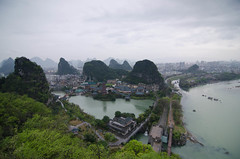
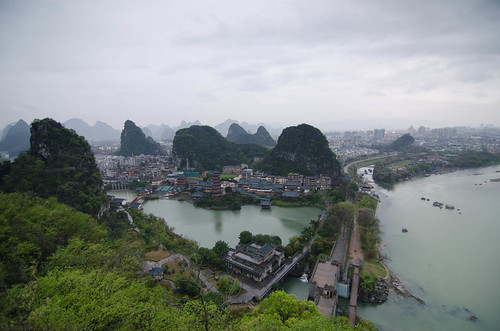
City by the Li RiverOn our last day from Guilin Kolok and I left the hotel at 5 am as we got on the scooter the rain began falling. We headed to DieCai Shan, another small mountain karst that overlooks the city; didn’t look like there was going to be much of a sunrise. We climbed the steps in the rain and arrived at the summit where a small pagoda stood. There was no refuge from the rain as the wind blew in sideways. There was at least 40 minutes until the “sunrise” and it was miserable. I was ready to go home, but rather than give up we descended to a much larger platform on the mountain’s side and waited dry until things began to lighten. We walked up the last hundred feet ago as the sky cleared and the rain stopped. There was no sunrise to speak of but the air was exceptionally clear as a strong wind had blown out the clouds. I got a few great photos of the city in grey and we descended. Time to start packing up and get ready for our departure to Yangshuo.

Yangshuo
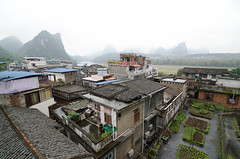
YangshuoThe bus station in Guliin is crowded and a bus leaves every 15 minutes for Yangshuo, a journey of 65 km. Unfortunately since we were traveling during QingMingJie things were very crowded and we wouldn’t be able to leave for 2 hours. So Kolok went in search of a taxi, he was able to locate a small van which took us for around $30 US. We arrived in the rain and got settled into our hotel. Kolok wasn’t planning on spending the evening in Yangshuo but was going to show us around. Sofi and I decided to accompany him on a boat ride on the Li River to fishing village called Jianguo which was around an hour’s ride away. There are many different kinds of boats on the Li. There are large boats with multi-decks that have kitchens on the back that will take you touring and can even be ridden on a four hour cruise from Guilin to Yangshuo. The most common is a “bamboo raft” boat which is between 2-3 meters wide and 5-6 meters long; traditionally these were made from large bamboo but now a-days are built from white pvc pipe (they last longer). The ends of the raft are curved up on either end and the middle is covered by a small pavilion with three or four bench seats that can seat two adults comfortably. The captain sits on the back of the boat wielding a long lever attached to a longer motor shaft with a small propeller on the end, the kind you see in movies on the boats in Thailand (remember the James Bond movie : The Man with the Golden Gun). The boats ride very close to the water and yet they are very stable.
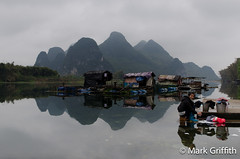
LiuGongOur captain was a woman that Kolok knew from his many trips to the area. Her family had only recently in the past two years left living on a house boat for living on a house on land. We weaved in and out of other rafts and before to long we were the only boat on the river as we headed for the fishing village. The weather was still cold and Sofi and I bundled up in a thick old army coat to ward off the cold that with the humidity cut like a knife. As we arrived at LiuGong there was a woman washing her clothes in the river, she helped pull the raft on land and Sofi, Kolok and myself hopped off. A water buffalo eyed us curiously as it chewed on grass on a small hill above us. We took a short hike that climbed up the side of the cliff onto a bluff that overlooked the river, there were nice views of the field on the otherside of the river that were lined with bamboo. We could see farmers and water buffalo grazing across the way. We walked through some fields to the back of the village and back down the boat where we road back into Yangshuo. Kolok gave us several more ideas for places we could visit and then departed and headed back home to Guilin.
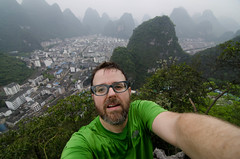
Yangshou Dawn PatrolThe next morning I tried for one last Dawn Patrol, still hoping to catch a sunrise. I left the hotel at 5:30 am. Immediately a guy on a motorcycle drove up and asked if I wanted a ride. I asked home much and he said 5 rmb (.90 cents) and he dropped me off at Bilianfeng Park. I’d checked the day before they didn’t open until 8, the entrance way was covered with an 8 foot piece of heavy fabric that was pulled taut and padlocked on either end. But I was able to pull up the fabric and the bottom, push my pack in and slide under. As I did so, a guy wiping sleep from his eyes wandered out of the entrance building and started yelling at me that I was permitted to enter. I told him I was willing to pay the entrance fee, but he refused; unlocked the “gate” and made me leave. So I started walking to Yangshuo Park. I hadn’t seen the layout previously and I wandered around looking for a way to get up on top of something. By the time I found the steps leading up the sunrise had already begun, but no worries since there was really no sun to speak off. The steps ended after a hundred feet, 300-400 feet of karst remained until the top. There was a faint “trail” leading up so I scrambled up the vegetation and limestone, until eventually I arrived at the top. Fantastic views of Yangshuo lay below me. No sunrise, but elevation gained and beauty found.
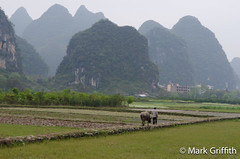
The Buffalo RoamLater that morning Stac’s arm was still in considerable pain and so the kids and I planned an excursion. We wandered down to West Street where the tourism is thick, fast and furious. Yangshuo is much smaller than Guilin. Its nestled in a small valley surrounded by karst mountains on three sides and the Li River on the other. It’s unabashed about the fact that its a tourist destination, there are shops, restaurants and bars all aimed at attracting your tourist rmb. And there are way more Chinese tourists than westerners, though you see a lot of westerners. And there is a lot of western food available as well. We ate wood fired pizza, burgers, schwarma, falafel and hummus. We approached a vendor who rented scooters. I asked for a big one. She asked for a 500 rmb deposit and collected the 120 rmb rental fee up front. She showed me the gas was full and instructed me to bring it back full and she gave me my helmet. No contract, no paper work, no waiver just cold hard cash. I asked for two extra helmets, one for Sofi and one for Miles : no problem, no questions. Miles sat in front of me, and Sofi sat behind me and off we went. This was no different than what hundreds of other Chinese families do. Stac and I even saw a family of 5 riding a single scooter in Taiwan.
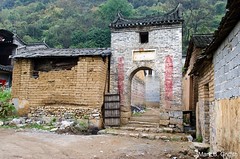
Entrance to Jiuxian VilliageWe headed south out of Yangshuo on a small paved single lane country road heading for the village of JiuXian that Kolok had told us about. The back road there is fantastic, its a small valley that winds through karsts, it felt very akin to driving through a green version of Zions National Park in southern Utah. The road parallels the Yulong river and eventually the road ends at a launching point on the river where you can ride a bamboo raft. From here we took a very muddy “road” north east to the main dirt road that leads to Jiuxian. This road was extremely slippery from all the rain and several times I had to put down my feet to steady us. Finally on the “main road” we drove through the small country towns until we reached the village of JiuXian. Here houses 400 years old remain in the same condition as they have for generations. We stopped at a small restaurant and ordered a several dishes for lunch. Miles had his usual plate of fried rice, while Sofi and I chewed on some bony chicken and some eggplant.
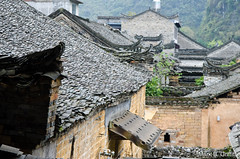
Jiuxian VilliageI stopped to chat with several old men sitting on the side of road. They were 74, 82, 71 and 83 years old. I told them their village was beautiful and they said not so, they were poor and no money. Sad to think what electricity and TV has done to make people’s expectations rise unnecessarily. We made our way back on the main road to Yangshuo and returned the scooter.
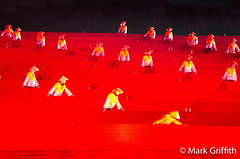
Impressions of RedThat evening the entire family, including Stac with her arm in pain went and saw Impressions Liu Sanjie Water Show in Yangshuo. The setting is the Li River in a small bay with limestone karsts surrounding it. The entire show is preformed on the water, with most of the participants using bamboo rafts to maneuver. The show was directed by Zhang YiMou, who did the opening and closing ceremonies at the Olympics and is full of light and color. Without understanding the language the story there are plenty of fantastic visuals. That evening Stac had finally had enough of the pain with no pain pills so we decided the next day (Wednesday) would be our last and we’d head home early to Beijing on Thursday where Stac could get some pain killers and get her arm checked out again.
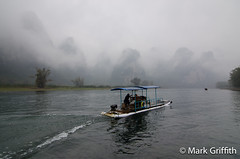
Rafting the Li RiverWednesday morning the kids and went on one last excursion. Our destination was XingPing, a small town 40 minutes north east of Yangshuo by bus. We walked down to West Street where we were approached by a Chinese local Miki. She offered to guide us to XingPing, accompany us on the boat up to YuChen (Fish Villiage) and down to 9 Horse Mountain. She ended up being fantastic, she speaks good “guide English” (meaning she has really good basic English and has good understanding but choose simple words and phrases), all of which she has learned her self over the past ten years. She has a little black book that she carries around with English phrases and their Chinese translations as well as recommendations from past clients written in every language you can imagine : Chinese, Korean, Japanese, English, Spanish, French, German etc. Her husband is a rice farmer, he’s just left for Hunan to work in construction for a couple of months to earn extra money (a common practice in China). She lives at Moon Hill, south west of Yangshuo and rides her bike 40 minutes into Yangshuo each day. She is very friendly, honest and knowledgeable about the local area. I highly reccomend her if your in the Yangshuo area and you need a guide. A guide will really help you get to and see places easily, get bus tickets, order food, rent bikes or scooters, reserve boats etc. They are worth their weight in gold, especially one that is honest and genuine like Miki. Her mobile phone is 15878367912, give her a call if you visit the area.
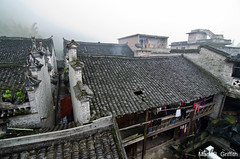
Fish VilliageThe bus ride to XingPing was 28 rmb for the four of us and was uneventful though it was very bumpy due to the condition of the road. Of course by this time uneventful meant we paid no attention to the driving, the honking, the passing on hills or turns, just normal country driving. The rain was falling in XingPing and we were glad we’d come prepared with our raincoats. The wind blew the mist on the raft onto us and we were pretty wet by the time we arrived at YuChen (Fish Village). I purchased three umbrellas for me and the kids, mine was pink one with flowers, the only color available in large. We explored the village, which was proud of its heritage. In one hall hung pictures of famous visitors : Deng Xiaoping (former president of China) in 1978 and President Clinton in 1994. One lady charged us 1rmb per kid for them to use the bathroom and a half rmb for me to go up on the roof and take a picture of the village.
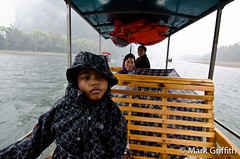
River RatThe ride back down the river towards XingPing and then to 9 Horse Mountain was a bit drier thanks to our umbrellas. Miles though was cold and done with riding on the river and started crying and complaining. So we rode until we could see the mountain in the mist and then turned back to XingPing. The bus ride back to Yangshuo was crowded. They are privately operated and the more people they can cram on, even without seats the more money they make. We said goodbye to a Miki and tromped back to our hotel cold and tired.

We packed our bags and prepared to return home. We’d had a wet time in beautiful green Guilin and Yangshuo. We’d seen the more adventurous side of things thanks to local guides. Sadly Stac had a pretty awful time due to her arm. But we’ll be back to explore more of this beautiful countryside.

More Information

Categories: By Mark, outdoors, travel, travel in china | Tags: , , | 1 Comment

We made it!!!

I love how smells and a feeling can take us back in time. When I smell fresh peas I think of my grandma Scott (who passed away when I was 16 and was my last living grandparent) because she had peas in her garden and would let us kids go pick as many as we could eat. I loved sitting in her kitchen with her. Usually she would be at the sink washing dishes or washing other veggies that we picked and I would sit at the table eating the fresh peas from her backyard. I can still see her smiling face and hear her laugh.

GuilinWhen I walked out of the plane here in Guilin I was hit with humidity and a smell that took me right back to Taiwan. I’ve been in China for almost 2 months and haven’t had a deja vu moment until yesterday. Guilin is at the same latitude as Taiwan and looks and feels very much the same. All I need now is a big whiff of Cho tofu and I will be transported back in time.

With the crazy morning we’d had at the airport in Beijing and then the full totally crammed three-hour flight to Guilin, none of us had used the bathroom. We stepped off the plane and made a mad dash to the restrooms. I loved that they had both squatters (for the Chinese, not me) and then stalls with little plastic toilet seats on the door (for people like me). I was very relieved.

Guilin pagoda's.I loved the hour drive to the city of Guilin and kept making comments to Mark about how much I felt like I was in Taiwan. No more dry Beijing weather for us for a week. We got to our hotel to find out that our room wasn’t ready so they bumped us up to a better room but we still couldn’t check in for almost an hour. We are right across the street from the Li River (with the beautiful Guilin mountains in the background). Our hotel is really close to some little alleys with shops and restaurants so we headed around the corner to get a late lunch. Guilin has a lot of restaurants with outdoor seating and has a bit of a European feel to it. We ate at a yummy place and sat and watched people walking around.

Sugarcane manWe had a great first day walking around the city and the river. One of the many things I love about China is all the food you can buy from vendors on the streets., plus it’s so cheap and a great treat for the kids. Guilin has plenty to choose from. We walked along the river with the kids and then through a park. Sofi had to buy some sugar cane of course (her favorite). The man selling it has a sharp peeler and shaves the cane and then wraps one end in a plastic bag and gives an extra bag so that you can spit the cane into it. Miles got a cane of his own but didn’t like it so much plus he’s not a pro at eating it like Sofi and he kept dripping sugar water all over himself. He wanted corn on the cob (which I ended up paying too much for and it was woody). On our third try of finding something Miles could eat, we bought a bag of lychees. He went crazy and kept eating one after another. can you say "lychee"?

It was an awful morning getting out of Beijing but once we got to Guilin it was perfect. I’m definitely noticing more people staring at the kids and curious enough to even ask us if Mark and I are their parents. We had a lot of people staring at us and taking photos of the kids. The kids are learning to tune it out and have been really good about it. At their age I’m not sure I would’ve liked having strangers rubbing my hair and touching my skin. I’ve been very proud of my kids though and I’m happy that they aren’t offended by it.

Pagoda'sI’m on the lookout for dried ants, which I’ve been told by a friend is a special treat from Guilin. I’m curious if Miles will try them? Oh, did I mention that the mountain range in Guilin is as amazing as it looks in photos and movies? Not to rub it in or anything but it is very picturesque and peaceful. If you read this Kiah, I’m very sorry.

Categories: By Stacey, travel in china | Leave a comment

Guilin or Bust – Busted

Our first domestic vacation in China started out way too early and entirely on the wrong foot.

Welcome to Guilin

Originally I had thought that I was booking the flights for 7:30 in the evening on Friday but it turned out they were for 7:30 am. When I realized this on Tuesday this started a series of time compressions as I had to rearrange my Friday schedule and rush to get everything done in time;  things weren’t leading up to our travel day well.  Friday was demo day in Seattle and I had a lot to get ready for it. Demo day is a chance for a developer to demonstrate they work they’ve completed in the past month.  I’ve been filming the developers here in China talking about their projects and then editing them together and uploading them for Seattle to view.  This is not typically that big of a deal but it does take a couple of hours to complete.  My last demo day editing experience was my first time editing on a Mac (my wife’s since our PC still was in transit from the US) and was interrupted by a trip to the “ER” with my wife for a Migraine; I was hoping this time would be smoother. The fact that I had to finish the night before we departed when I also had pack wasn’t too bad but then my iPhone ended up dying on me!  The battery went flaming hot for the past two days and the entire day Thursday it wouldn’t charge past 2%.

I sent a “Help” email to the GM of the Apple Store in Beijing who I’d been introduced to by Robert (a gentleman that works for the agency who provided our driver) and rushed home.  Robert called the GM’s home and his wife said he was flying to the states but to go down to the store and she gave him the name of the managers to ask for.  I hoped in a cab and rode down to Sanlitun to The Village where the Apple Store is located and at the front door asked for the manager.  The employee quickly grabbed the guy in charge and he pulled the serial number and immediately went to swap out my iPhone.  My experience with the service at the Beijing Apple Store has been phenomenal.  After completing the switch I started back home riding in one of this enclosed little tut-tut motorcycle cabs. We’d settled on 20 rmb before leaving, which was double the price of a normal taxi but I didn’t see any around and didn’t feel like waiting.  I should have waited. The motor-cabs are slow. I’d told him I lived near Chao Yang Park (think big like Central Park in NYC) and as soon as he saw the park he kept asking me how much further.  When we finally arrived at our apartment complex he complained how far it was and when I gave him a 20 rmb note he asked me for 50. I refused telling him we’d agreed on 20 and that not only was his cab slower but it was more expensive.  He asked for 30 rmb and I just shook my head and walked off to our building.

Arriving home I re-synched my iPhone and started editing the demo video; I finished around 11 and then started finishing my packing and all the extra stuff that had to be thrown together : charge cords for the various electrical devices, camera gear, tripod, running clothes etc.  I finished up around midnight and crawled into bed, not looking forward to the 5 am alarm and our 5:45 am departure.  The klaxon alarm woke me up and everyone rushed around to get ready and out the door.  Mr. Wang drove us to Terminal 3 and we went inside to check in for our Air China flight to Guilin.  We waited in line and were at the counter in a few minutes.  The attendant who spoke a little English told me that my kids tickets were open but that Stac’s and ours was closed.   I had booked them on Ctrip, it was easy and quick.  I had sent them an email asking for any special details required for flights inside China but I never heard anything back.  A coworker said I should print out our flight confirmations, just like we do in the States, and that should be sufficient.  The site confirmed they were purchased and I’d already seen the charge show up on our statement, but something was wrong.  I dialed the phone number from their website and pressed two for the English service.  “English is not available until 7am”.

Uggh…  The attendant had called over another airline representative, you know those ones that stand in front of the check in counters and help people.  I asked if she would help me and I dialed C-trip and handed her the phone. The time was 6:37 am, the counter closed at 7 and our flight was to depart at 7:30.  She spoke with someone for several minutes and then said it would be ok and please wait 5 minutes.  I stood to the side of the counter while everyone else checked in; five minutes later I asked the attendant to check.  Stac and I’s tickets were still closed.  Another 5 minutes passed, still closed.  I called C-trip back, it was still too early for English so I got an Chinese speaking agent on the phone and handed it to the airline attendant.  He talked with them for a minute or two, raised his voice at them and then hung up.  He said 5 more minutes. After three more “5 more minutes” and two more phone calls with the airline attendant trying to talk to C-trip on the phone and check people in he finally hung up the phone in disgust and handed it back to me.  At 7:15 he told me that I would have to buy tickets for the next flight and he pointed me to the ticket counter adjacent.

C-Trip called me back and started rapid fire Chinese.  I told her that she was speaking too fast and I didn’t understand.  Rapid fire Chinese continued.  By now I was a little upset to say the least so I just started speaking to her really fast in English.  We got someone in English on Stacey’s phone and I asked them if they could fix the problem. She said her supervisor wasn’t there right now and so I said take care of it ourselves and I wanted her to refund my money.  We went up the counter to enquire about tickets. The next flight was 8:30 am, but it was in Terminal 1, we were in Terminal 3.  It was 7:30.  The ticket agent went through the process of purchasing tickets, which seemed awfully slow given we were in a hurry, but she had to input our passport numbers manually for each ticket.  She told me there was only first class tickets available for the adults, which were only about 500 rmb more expensive than our original tickets.  So I said yes, I just wanted to get underway. Finally at 7:40 we had our tickets in hand and we went in search of a taxi, we didn’t have enough time to wait for the shuttle bus.

We waited in the taxi line agonizingly watching the minutes slip by.  At 7:50 we got in our taxi. I could tell he wasn’t happy that he had waited in line all that time and now was going to get a cheap fare to the next terminal. I told him don’t worry I’ll pay you.  The terminals were quite some distance apart and we didn’t arrive until 8:03 am.  The meter read 12 rmb but I gave him a 50 for his trouble.  We butted at the front of the line; apologized and checked out one bag.  Even though they’d told us first class we all ended up with economy seats at the rear of the plane.  Every seat was in a different row, no one would be sitting together but at least the kids wouldn’t fight. We made it through the security and to the gate by 8:15.  We boarded at 8:20 and then sat on the runway for 30 minutes.  Finally at 8:50 we were in the air.  Let the vacation begin.  Hopefully things get better. 😉

[Since arriving in Gulin Ctrip has called me back and to their credit they paid the cancellation fee for the flight we didn’t take and they gave me credit in their system for the difference paid for the flight]

Categories: By Mark, travel, travel in china | 5 Comments

Student Led

The Bridge Between

I’ve had the opportunity over the past several weeks to spend several visits at the kids school, Beijing City International School.  I had the chance to meet twice with an education consultant, John Littleford,  the school had hired to do an assessment.  He conducted a series of interviews I’ve already written about.  I also had a chance to review the results of those assessments and to listen to him speak about his experience as an educator and a consultant to international schools.

John has a fascinating story that I found quite compelling and inspiring, perhaps because some of it reminded me of my own journey albeit on a much smaller scale.  I’d really enjoy reading a history of John’s experience and I hope he writes it down someday.   I was particularly impressed with his discussion about how schools that create a need in students, inspire them to great achievements.  Stac has written a little bit about how an international school is an environment where kids have greater opportunities to bond together.  A new kid in a new school is the odd man out, but when everyone is new they are drawn together faster and with a stronger need.  I’ve been amazed at how Sofi and Miles have both progressed.

I also had the opportunity to go to coffee with the Middle School principal, meet a couple of other mothers of children in Sofi’s grade and tour around the classrooms. I still don’t really feel I’ve had as much opportunity to connect with Sofi’s teachers, but its mostly a factor of Miles having a single class and Sofi having many.

Today Stac and I had the opportunity to both attend the Student Led Conference sessions at BCIS.  This is a time when the students get to show their parents their academic work over the course of the past year. This is collected into a portfolio and students walk their parents through their accomplishments, projects and around to their various classrooms.

Sun JianSofi presented us with an overview of her social studies, where she has been learning about stereotypes of child soldiers in Africa and her English assignment where they are reading the book Holes.  We went and met her Chinese teacher and chatted for a few moments. Sofi has come along quite quickly in her Chinese, given how short of a time we’ve been here; she really has a desire to learn and is not afraid to make an effort to try and speak. She is soon going to be out speaking me.

Miles MonetMiles was completely and totally bored with Sofi’s presentation, but was so excited to share with us the work he’d done. He pushed us (literally) through the school from the Middle School section to his 1st grade class.  We were early so we waited outside until our specified time. Miles walked us through his written school work, then we went over his inquiry based sessions which focused on light and finally we reviewed his math work.  Diba Kader and MilesMiles really loves math and is quite good at it (Sofi too).  This sometimes baffles me since I’ve always been so math averse, but I am glad they enjoy it and are good at it.  Afterwords Miles wanted us to walk around to each of the different specialty classrooms : Chinese, music, PE and swimming. We were really bummed that we forgot his swimming suit and missed out on a swimming demonstration.

Once again I was impressed by how BCIS provided an opportunity and environment where the students could shine and direct their parents through their educational achievements; another fine example of encouraging the kids to become self sufficient and educated citizens of the world.

Categories: bcis, By Mark, living in beijing, school | 16 Comments

The Familiar

Many folks back in the states seem to react in shock at times about our decision to move to China. I still meet people here (at work) who are visiting from the States :

  • “Hey what are you doing here? (Cause they expect to see me in Seattle not Beijing)
  • “I live here.”
  • “You do?”
  • “Yup”
  • “Did you bring your family?” (incredulously)

Living in Asia can be a huge adjustment for some people.  Just leaving your home environment, your home culture can be overwhelming. Too much for some people to even consider.  Stac and I had both lived in Asia twice before in our trips to Taiwan. This made it easier but not without an understanding at the same time of what we were getting ourselves into.  When we lived in Taiwan we went with basically nothing. While we did have Kiah the second time we went she was only 18 months and didn’t attend school. We slept on mattresses donated or given to us on the floor; we drove around on scooters without helmets; we ate food purchased off the street and never cooked; we lived out of suitcases with our things stacked on the floor and in plastic “toy” closets.  Things were much different this time around and being in a more secure and comfortable environment was much more important with our family.

Some of our key considerations were : where our kids would go to school and where we’d live.   You can read more about what we looked for in housing here, but having a place that was close to work and school was the primary requirements.   Not just the where, but how we’d live was also important.  Based on our relocation budget we also wanted to feel comfortable.  In a situation like Beijing when you have so much that is different or less convenient it was important to have a haven, a place that is your refuge from all the crazy and inconvenient.  Having a nice place with our own art hanging on the walls, and a few nicks and things makes a huge difference.

Living as an expat in Beijing is a very different experience from coming here as a student, just like traveling on a company business account is different from traveling as a student. Amazon has a very strict rule about frugality which I really appreciate. And yet at times the entire expat experience feels like its set up a little bit like a racket. Most of the international schools coincidentally charge around the same yearly tuition. The relocation companies and the real estate agents steer you towards apartment complexes that are western oriented and are not a “local product”. Granted there is good reason for some of this. The apartment where we live has a management staff that speaks English, and its amazingly reassuring to be able to call them up and get help in your own language.

Most all of this is possible otherwise, we did it in Taiwan many years ago but you end up relying on friends and a lot more pantomime and dictionary hunting to get your meaning across. (I still know how to say water pressure from an incident in Taiwan were our water tank on the roof was broken).  As noted with a family it was important to to have a place of comfort, a place to be able to call home. Your shelter from the storm. Your refuge from the pollution, the traffic and the people.

And so I sit in an apartment on the 29th floor that is larger than 90% of the population in China. I am comfortable and yet conflicted at the same time.  I am close to work, around 70 minutes closer than most of the people I work with.  We have hired an Ayi to help clean, and run errands. All of this can seem egregious and and exploitative, and yet the Ayi is not that expensive relative to our income and she is very grateful for the job.  I remember a quote from an economics professor once : “The only thing worse than being exploited is not being exploited”  Meaning that we can criticize the exploitation of workers in foreign lands by foreign companies, such as Nike opening a plant in Vietnam, and yet the wage while not what they’d pay in the US, raises the base income in an impoverished situation and improves peoples lives.  I suppose its the attitude with which we approach individuals and treat them that is a key differentiator.  Some other time I’ll cover a host of thing that are different and balance things out. In the meantime I do appreciate the familiar and the comfort it brings among all that is not normal.  I hope I can remain always grateful and keep the proper perspective on the experience.

Categories: By Mark, living in beijing, moving, relocation | 6 Comments

Seven, Tong Tong and Mao

four peeps and a babyToday I met my soon to be tutor, Seven. She chose that as her English name because her Chinese name is “Chimei” which is Seven sisters. Now that I’ve met Seven, it fits. What sounded like an interesting and maybe a strange name to choose for oneself, now just sounds right.
She came to our house (probably about an hour drive with traffic) today with her 1 1/2 month old baby Tong Tong, her mom Mao, Jeanette and Nicole. Jeanette and Nicole already seem like old friends, it was good to see them again. All of these people we’ve been able to meet is because of a friend I made online that lives in the states.

New friendsTeresa lived in Beijing for a little over 2 yrs and is good friends with all these wonderful people. Before moving to Beijing I searched online for a blog by anyone that was either living in Beijing or had lived in Beijing and could give me some pointers. I discovered Teresa’s blog and soon became addicted to it and she posted about EVERYTHING, so there was a lot to read. It soon became my daily ritual, to read one of her posts. I felt sad when the Beijing blog was over but thank goodness she is still blogging.

Seven is going to take a taxi three times a week with her mom and baby in tow to tutor me for two hours. Her mom lives close to me and her mom can come sit with the baby while Seven tutors me but still, it’s out of the way and I’m really grateful she is willing to do this. Of course she is being paid but it goes beyond that and I really appreciate it. The Chinese people are gracious, kind and so friendly.

Ok, this is off topic but I wanted to make a point about Chinese people. We will be in the elevator of our apartment (there are 31 floors plus four floors of penthouses in other words, there are a lot of people that live just in our building) and someone will get on, say “Ni Hao” then if they get off before us they turn and say “Zijian”. When do you ever do that in the states? Most of the time in the US in the elevator I tend to ignore the other people in there with me, almost to the point of not making eye contact. Why is that? I just wanted to say that the Chinese are very friendly and we have been treated so well since getting here.
yawning
Ok, back to Seven and her visit. Her baby is beautiful but when I would say that to her or her mom, they would say “oh, no she is not”. I could’ve just squeezed her cute little cheeks though, so cute. Mao (Seven’s mom and the way we were introduced to her was by telling us her name is Mao, like the chairman) took off Tong Tong’s sock to show us her “big feet” and then tried to tell us because they are so big (and she was just born in February) it’s too much of a pain to find shoes or socks that fit. Ha ha. They looked like any other newborns feet, cute and tiny.

Two happy peeps and a not so happy babyI think I might be distracted by the sweet baby when Seven comes to tutor me but I will try my hardest to study and pay attention. I’m ready to learn so that I can stop stumbling over the few words that I know. I want to remember to say “xiexie” (thank you) to our driver, instead of blurting out “zijian” (goodbye) when I first see him and he opens the door for me. I’m sure I sound like an idiot but I am trying. Also, supposedly learning the tones is no big deal, so Sofi says. Sure!

Zijian!

Categories: By Stacey, friends, living in beijing | 4 Comments

Sofi blossoms

Growing up Too FastThe person I was most worried about with moving to Beijing was Sofia. She was in the middle year of 6th grade, in middle school. Never an easy time in anyone’s life. There are cliques, teasing and worrying about who is more popular etc…. For whatever reason Sofi back in the states wasn’t putting herself out there that much to be with friends and make plans and she’s an outgoing kid.

When we got to China she was upset the 1st week because of jet-lag(there was a lot of crying and meltdowns each night) and being scared. She wanted to go home, she never had a say in coming to China and she didn’t like it here. Luckily the jet-lag wore off, Chinese New year ended and school started. Too much time hanging out in a hotel with your 7 yr old brother and missing home causes too many “what ifs” and boredom.

FriendsOn Sofi’s first day she was assigned a buddy that happens to live in our apartment complex and is in Sofi’s class to show her around. They hit it off and now are great friends. At BCIS there are a bunch of 6th grade classes but each homeroom class spends the remainder of the day together. Sofi’s homeroom class has about 15 kids in it and they go from one subject to another with each other. I love that. It hasn’t stopped her from meeting other kids outside of her group but it does force an instant bond within the group because they are together all the time.

Cotton CandyShe has already made some great friends. They’ve had sleep-overs, shopping trips, a day at the park across from our apartment where they went on roller coaster rides and one night they fixed dinner for our family and one other family. They get all dressed up to go shopping and go to a market where they bargain for bags, shoes and clothes. She’s literally blossomed and as a parent it’s such a blessing to see.

Kicking ItI think because the kids at her school are constantly moving (some spending no longer than 3 yrs at one school) and haven’t gone to school together since kindergarten that they have to quickly move past the nervous stage and jump right in and make friends. There isn’t much time for cliques that I’ve seen. One mom said to us that the kids are “citizens of the world, not citizens of their town”. I totally agree with that. That might sound sad to some but to me, I think it’s exciting. My sister-in-law spent two years of her HS years in Japan. She was the one I would call when I was worried we might be making a mistake taking our kids out of their comfort zones and transplanting them in a foreign country that they didn’t speak the language. She would tell me that for a long time after HS she kept in touch with the friends she made in Japan and that it was the best decision her parents made. I know that even with Sofi making friends and them possibly moving before we head back to the states that she will remain in contact with them and they will be friends for a long time. They’ve formed this strong bond and I’m so excited for her and for Miles. Though I was worried for Sofi the most, I now feel she will benefit the most from being here.

Categories: By Stacey, living in beijing, moving, school, sofia | 6 Comments

Biking to Work

Traffic in Beijing

This is a video taken while biking to work. It’s shot with a GoPro HD camera that I’ve mounted to the handlebars of my bike.  I live around 1.6 miles from work and biking usually takes me around 10 minutes.

Biking in Beijing is generally very safe once you adapt to the “rules of the road”.  First things first no one wears a helmet biking, except for me.  Secondly you must be on high alert constantly. That doesn’t mean that you can’t ride at a leisurely pace, just your always watching and on the lookout. In fact most folks that ride bikes do so not for exercise but as a mode of transportation, thus the majority of them are not really riding very fast at all. In fact I ride at least twice as fast as anyone around me, maybe even three times as fast. Your hands always have to be on the handlebars and you have to be flexible and fluid in getting from point a to point b, you have to weave and flow. You’ll notice in the video that the concept of lane and direction is very loose. You’ll see motorcycles and even cars going the “wrong way” on your side of the road coming straight at you.

Most major roads have an actual lane dedicated for bicycles, these lanes are very often an entire lane, that is a car width wide and are completely segregated from the adjacent road by a cement curb or barrier. I happen to bike down a couple of back streets where there are no bike lanes.

Intersections and left hand turns are a combination of “might makes right” and encroachment. When there is an actual left hand turn signal at a light the light generally governs the turn. And yet there is nothing to prevent someone on a bike or a pedestrian from turning early, making their way part way across the street or intersection; stopping in the middle of the road between the lanes of traffic. Where there are no turn signals it’s a matter of inching your way out into the on-coming traffic. Much of this depends on force majeure, meaning if you have more with you than with them you can force a break. A lot of it depends on flow, the contiguous constant trickle of vehicles. An example from this morning. A van and myself (me + a van is much more of a force than just me on my bike) were attempting to turn left at a bend in the road where the majority of the oncoming cars were themselves turning left (or our right). There were about 8 oncoming cars in a row (contiguity). The van and myself kept inching our way out into the lane, forcing the oncoming cars turning left to keep cutting to their left into their oncoming lane that we were attempting to turn left into ourselves. This was possible because there were no cars on their left. Eventually there would have been a pinch point where they wouldn’t have been able to squeeze through and we could have crossed but as it was all 8 cars made it through and then there was a gap and we crossed. Likewise a large enough force on our side could have caused one of them to flinch and stop letting us through. Or one of them could have flinched anyway, or one of us could have been bold enough to actually force the issue and stick your wheel out and made them stop. A lot of it depends on how fast they are coming and how daring you feel like being.

And all of this is fluid. Too many cars coming to turn left : then stay on their left and ride the wrong way into the oncoming bicycle traffic. Amazingly there are no accidents (none that I’ve seen), people don’t get angry or yell or flip people off. It’s not that people aren’t obeying the rules, its just that the rules are different and what we consider road-rageable is just your average every day occurrence and everyone is adapted and accustomed to it. Things may not be as orderly as in the States, but 25 million people going to and fro everyday can’t all be wrong; at least if you adapt and go with the flow.

Categories: biking, By Mark, commuting, living in beijing, work | 8 Comments

The Last Logistical Bits

The last logistical bit of relocation bureaucracy is complete, our air shipments were delivered today at our apartment in Beijing. I’ll review a few details and things that I understand better now.

Here is a tour of our Apartment

Beijing Apartment Tour from mbgriffi on Vimeo.

I wrote the about the process of getting permits and visas, but after having gone through it I understand it a little better. When applying to work in China the first thing you get is a Z-Visa, this is single entry visa good for 30 days and allows you to enter the country and apply for the residency visa. Your family also has their own Z-visas in their passports. The first thing you do when you arrive in country is you get your temporary residency permit; if your staying in a hotel or furnished apartment typically the will apply on your behalf. This is required within 24 hours of your arrival at a new address. This is a registration at the police station that just registers where you are living. No matter what visa type you have, when you move to a new address you always register at the police station and you receive a temporary residency permit. This is a small piece of paper that you are to keep with your passport at all times.  Moving addresses and having to change your temporary residency permit during the process of applying for your other permits can invalidate the process so its good to stay put for those first 30 days.

Next you apply for a work permit. This is good for one year and is a separate purple booklet that allows you to work in China.   After you have this document then you apply for a residency permit. This is a visa in your passport, that you apply for with the immigration branch of the Public Security Bureau. This is good for one year and allows you to live in China and enter and exit the country. Despite you having this, you still need a temporary residency permit with the Police for the actual address where you live. Its confused me at first, because I couldn’t understand why after I had my “permanent” residency permit (visa) I still needed a temporary residency permit. They are two different permits with two different agencies for two different purposes.

These documents and processes were all handled by the immigration lawyers in China in conjunction with the work. After you have your work permit and your residency permit, which takes around 28 days, then you can actually get your goods through customs and into China. Our stuff was coming on a plane so until our paper work was finished the boxes just sat in a warehouse in the US; upon completion of the permits and visas they shipped our goods via air to China. Then a local freight company came and got my passport and work permit via courier as well as some customs forms I had to sign and fill out and they handled the processing of clearing our goods through customs. Once they cleared they delivered to our house and unpacked everything.

The Last Bits

The logistics coordinator told me that he thought our goods wouldn’t be available until next Wednesday, then suddenly on Friday I got an email and said they would clear that afternoon and they could deliver on Saturday! Deliver happened in the midst of a 9 hour ordeal getting Sofi’s hair braided. I left here there for a few hours and rushed home to meet the movers at 11:30 at our place. They were waiting for me on our floor outside the door. Since we only had two small air containers it only took them about 30 minutes to bring all the boxes and air crates inside. Remove everything from the boxes, place all the stuff on the floor, bed, counter top or couches and cart all the boxes away and be gone! We had to put everything away, which will take us a couple of days. The apartment complex management (which are so helpful, especially Miss Zhang) arranged for some workers to come hang photos on the walls. The logistics company had contacted a 3rd party who had quoted them 700 rmb, but these guys were only 400rmb. The measured and drilled and hung around 15-20 of our photos, paintings and art work on the wall. This was a lot of what our shipment was in fact, (besides a 100 lbs of camping gear) the photos really helped to make things feel like home.

I’ll post a video of the place and some more photos once we get everything put away.

Categories: By Mark, living in beijing, moving, relocation | 1 Comment